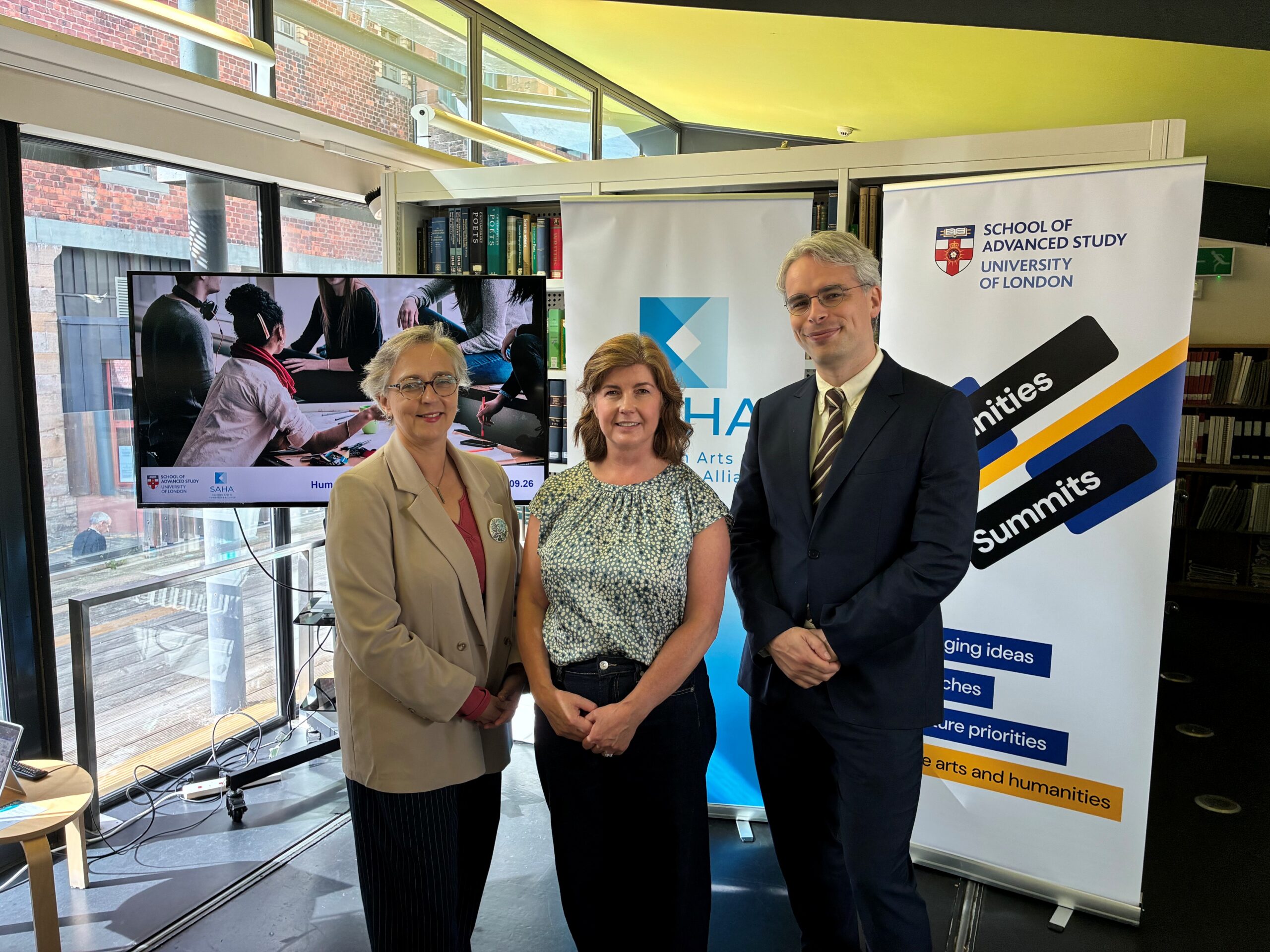
What does good place-based advocacy for the Arts and Humanities look like? That was the question posed at the start of last week’s Scottish Arts and Humanities Alliance (SAHA) meeting, held in association with the School of Advanced Study at the University of London in the airy environs of the Scottish Poetry Library in Edinburgh.
The emphasis on placed-based research has received a boost from the incoming Burnham administration, with its focus on the devolution of power but it has been a focus of academic research for many years, as we heard at this event. The new attention to the specific cultures, structures and needs of communities lies at the heart of our AHRC-funded project, ‘Transforming Cultures of Language Learning in Scotland, Wales, Northern Ireland and Ireland’ and so it was fitting that two of our team spoke as part of the event.
The first session was chaired by our CI, Professor Claire Gorrara, Dean of the School of Advanced Study, who led a discussion of the features of effective place-based advocacy. Delegates from across Scotland and the rest of the UK shared examples of effective practice and inspiring research projects, and identified the need for advocacy to be connected and embedded in communities for genuine impact and effectiveness. We also heard Professor Tom Crick, Chief Scientific Advisor at the Department for Culture, Media and Sport, and Dr Tom O’Connor, Executive Director, Partnerships, Portfolios & Engagement at the AHRC in conversation reflecting on how the thinking of funders and policy makers is evolving around questions of place.
Place is central to the research objectives of our project, which aims to identify the factors that underpin successful cultures of language learning through a comparative analysis of the situations of the Celtic jurisdictions. Each is shaped by its own jurisdictional education policy and by the approaches taken to implementation and delivery at a local and jurisdictional level. Beyond that, the project aims to understand how the social discourses produced by stakeholders in the macrosystem interact with policy to produce the attitudes and relationships that we have with languages.
In Scotland we have begun to engage in advocacy around languages, bringing together stakeholders across the learner lifecycle to co-ordinate and amplify our collective efforts. Key to this is the recent SAHA report, ‘Languages in a Global Scotland’, which offers a comprehensive picture of our current circumstances. After lunch, our PI Professor Fiona Barclay and SAHA’s Co-Chair of SAHA, Professor Catherine O’Leary, presented the situation of languages and discussed the recommendations of the SAHA report and how stakeholder groups including SAHA, the University Council for Languages Scotland, Fellows of the Royal Society of Edinburgh and SCILT, Scotland’s Centre for Languages are working together to raise the profile of languages in Scotland.
The findings of our project will play an important role in informing this work, providing much needed data and evidence to drive our place-based advocacy.
Photo, left to right: Prof Claire Gorrara, Prof Fiona Barclay, Dr Tim Hampson, project PDRA. © Elena Zolotariov.